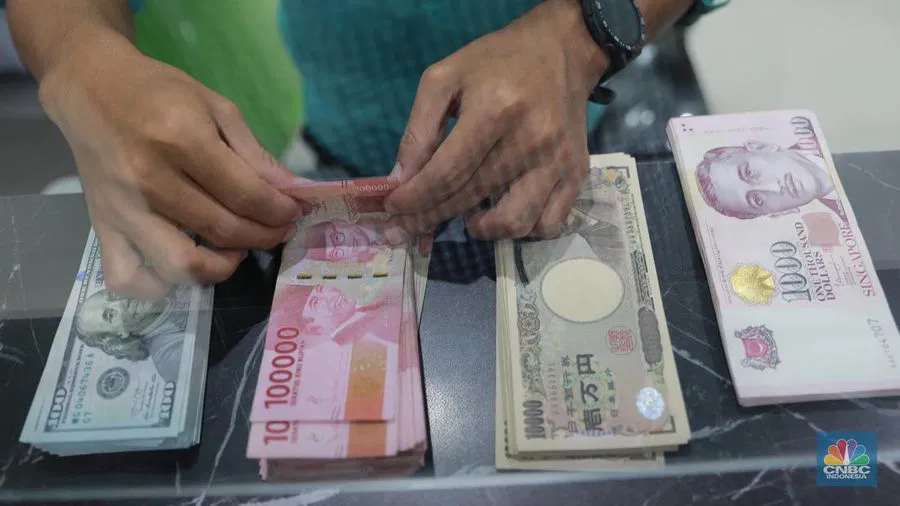
Indonesian markets traded mixed on Monday (9-Mar), with equities and bond markets still under pressure, while the rupiah strengthened modestly. The JCI index plunged by -3.27% (vs. -1.62% prior, or -8.04% cumulatively in the past week, or YTD: 15.14%), despite foreign investors returning to the equity market, reaching net inflows of +Rp1.1tn (vs. -Rp263bn prior; or +Rp2.23tn cumulatively in the past week, or -Rp6.18tn YTD). The daily turnover improved to Rp23.8tn (vs. Rp17.7tn prior; or Rp25tn avg. in the past week) but was still lower than the YTD avg. of Rp29.7tn. Regionally, Asian equity markets fell sharply as escalating geopolitical tensions in the Middle East triggered a spike in oil prices, prompting global risk-off sentiment. The Japanese Nikkei Index plunged by -5.20% (YTD: +4.75%), while the Korean KOSPI Index plunged by -5.95% (YTD: +24.62%).
In the bond market, rupiah government bonds weakened further as the yields profoundly increased across tenors, triggered by massive foreign outflows totaling -Rp5.2tn the highest daily foreign outflows since 29-Aug-2025. According to Bloomberg, the 5-yr FR109 yield spiked to 6.09% (+15.6 bps), the 10-yr FR108 to 6.73% (+13.9 bps), the 15-yr FR106 to 6.85% (+10.3 bps), and the 20-yr FR107 to 6.81% (+9.7 bps). Offshore indicators also weakened, with the 5-yr USD sovereign yield spiking to 4.59% (+10.5 bps) and the 5-yr CDS widening further to 92.53 (+6.96 bps). Meanwhile, the rupiah rebounded, strengthening slightly by +0.03% to Rp16,949/USD (vs. -0.38% prior; or -0.96% cumulatively in the past week, or YTD: -1.56%).
According to IDX s OTC trading report, Indonesian government bond trading activity strengthened on Monday (9-Mar), with the total volume rising to Rp36.2tn (vs. Rp21.5tn prior, or Rp35.5tn avg. daily turnover in the past week, or YTD avg.: Rp33.3tn). The 10-yr FR0108 benchmark series led market activity, recording Rp4.8tn in trading volume. This was followed by the 19.4-yr FR0107 and 9.4-yr FR0103 series, which recorded Rp3.8tn and Rp3.8tn in trading volume, respectively.
As of 6-Mar, foreign ownership in SBNs declined to Rp873.4tn (12.88% of total outstanding). Year-to-date, domestic investors have remained the primary buyers, led by insurance companies and pension funds (+Rp56.5tn), followed by onshore banks (+Rp54.5tn), other investors (+Rp43.1tn), Bank Indonesia (+Rp28.3tn), mutual funds (+Rp24.9tn), and retail investors (+Rp9.6tn). Foreign investors remained net sellers at -Rp5.2tn YTD.
The government will hold the last sukuk auction on Tuesday (10-Mar), with a target of Rp11tn, unchanged from the previous auction. The offered series include SPNSs (1-mo, 6-mo, and 9-mo tenors), as well as PBS030 (2.3-yr), PBS040 (4.7-yr), PBSG002 (7.6-yr), PBS034 (13.3-yr), and PBS038 (23.8-yr). Mirroring the latest conventional bond auction, we expect the total demand to be softer than in the previous auction, at Rp26tn (range: Rp21tn-31tn).
Domestic Corp Bond Market
On the corporate side, trading activity strengthened on Monday (9-Mar), with total volume increasing to Rp11.7tn (vs. Rp8.4tn prior, or Rp97tn avg daily turnover in the last week, or YTD avg.: Rp5.5tn). The ADMF07ACN3 series (maturing on 6-Mar-27), rated idAAA, was the most actively traded with a total volume of Rp920bn. Its price held steady at 100.00, while the yield virtually unchanged at 4.80% (-0.02 bps). This was followed by the FIFA07ACN3series (maturing on 6-Mar-27), rated AAA (idn)with a volume of Rp743bn. Its price declined to 100.05 (-0.05%), while the yield increased to 5.75% (+5.14 bps). Close behind was the SMFP08ACN2 series (maturing on 9-Mar-27), rated idAAA with a volume of Rp581bn. Its price rose to 100.02 (-0.02%), while the yield declined to 4.75% (+2.07 bps).
Pefindo has affirmed idA+ rating with stable outlook to PT Mora Telematika Indonesia Tbk (Moratel). Pefindo has also affirmed idA+ (sy) for the Mortel s Shelf Registered Sukuk Ijarah I and II. According to Pefindo, the rating reflects Moratel s strong market position, stable cash flow from the Palapa Ring West and East packages, as well as well-diversified customer and service base. Meanwhile, the rating is constrained by intense competition in the fixed broadband industry and regulatory risk associated with network expansion.
Pefindo has affirmed idA rating with stable outlook to PT Bali Towerindo Sentra Tbk (BALI) and idA(sy) rating for BALI s Shelf Registered Sukuk Ijarah I Year 2025. According to Pefindo, the rating reflects BALI s strong earnings visibility and stable profit margin, as well as diversified business. Meanwhile, the rating is constrained by intense competition in the industry and a moderate financial profile.
Fitch Ratings has revised the Outlook to Negative from Stable on the Long-Term Foreign-Currency Issuer Default Ratings (IDRs) of PT Bank Danamon Indonesia Tbk, PT Bank KB Indonesia Tbk, and PT Bank OCBC NISP Tbk, while affirming the ratings at ‘BBB’. The action follows the revision of the Outlook on Indonesia s sovereign rating to Negative. Fitch also revised the Outlook on the Long-Term Local-Currency IDRs of KB Bank and OCBC NISP to Negative, while affirming them at ‘BBB+’ and ‘A’, respectively. The Shareholder Support Ratings of all three banks were affirmed at ‘BBB’, reflecting strong expected support from their respective foreign parents. The rating outlook revision primarily reflects the constraint from Indonesia s sovereign rating and Country Ceiling, which cap the banks foreign-currency ratings, while Fitch continues to view parental support propensity and operational integration with their parent banks as strong. KB Bank s National Long-Term Rating was also affirmed at ‘AAA(idn)’ with a Stable Outlook.
Fitch Ratings has revised the Outlook to Negative from Stable on the Long-Term Foreign-Currency Issuer Default Ratings (IDRs) of four Indonesian state-owned banks-PT Bank Mandiri (Persero) Tbk, PT Bank Rakyat Indonesia (Persero) Tbk, PT Bank Negara Indonesia (Persero) Tbk, and Lembaga Pembiayaan Ekspor Indonesia (Indo Eximbank)-while affirming the ratings at ‘BBB’. The revision follows the change in the Outlook on Indonesia s sovereign rating to Negative. The rating actions reflect Fitch s view that while the government s propensity to support these banks remains strong due to their systemic importance and policy roles, the government s ability to provide support has weakened in line with the Negative sovereign outlook. Meanwhile, Fitch also affirmed the ratings of PT Bank Syariah Indonesia (Persero) Tbk (BSI), with its Long-Term IDR outlook remaining Stable, as the rating is primarily driven by its standalone credit profile reflected in its Viability Rating rather than government support.
Fitch Ratings has revised the Outlook to Negative from Stable on PT Bank Central Asia Tbk s (BCA) Long-Term Issuer Default Rating (IDR) while affirming the rating at ‘BBB’. The revision follows the change in the Outlook on Indonesia s sovereign rating to Negative. BCA s rating is driven by its strong standalone credit profile, reflected in a Viability Rating (VR) of ‘BBB’, the highest among domestic peers. However, Fitch expects the VR to remain constrained by the sovereign rating due to BCA s significant exposure to Indonesia s operating environment. Fitch also affirmed BCA s Government Support Rating (GSR) at ‘BBB-‘, reflecting the bank s systemic importance as the third-largest bank in Indonesia with around 12% of system deposits and its critical role in the country s payment infrastructure. The Negative Outlook mirrors the sovereign outlook and indicates that BCA s rating could be downgraded if Indonesia s sovereign rating is lowered.
Fitch Ratings Indonesia has affirmed PT Bank KB Bukopin Syariah s (KBBS) National Long-Term Rating at ‘AAA (idn)’ with a Stable Outlook and National Short-Term Rating at ‘F1+(idn)’. The affirmation reflects Fitch s expectation of strong extraordinary support from its ultimate parent, South Korea-based Kookmin Bank, through its majority shareholder PT Bank KB Indonesia Tbk (KB Bank), which owns 95.9% of KBBS. The rating is linked to KB Bank s Long-Term Local-Currency IDR, reflecting the expectation that any support would flow from Kookmin Bank through KB Bank to KBBS. Fitch also assesses a strong ability to provide support, given KBBS s small size relative to the group, although the propensity for support is considered moderate, supported by shared branding, reputational considerations, and KBBS s role as the group s sharia banking platform in Indonesia.
Fitch Ratings has revised the Outlook to Negative from Stable on PT Pelabuhan Indonesia (Persero) s (Pelindo) Long-Term Foreign-Currency Issuer Default Rating (IDR) while affirming the rating at ‘BBB’. Fitch also revised the Outlook on Pelindo s US dollar senior unsecured notes to Negative while affirming them at ‘BBB’. The Outlook revision follows the change in Indonesia s sovereign rating outlook to Negative, as Pelindo s ratings are capped by the sovereign rating under Fitch s Government-Related Entities (GRE) criteria. Despite this constraint, Pelindo maintains a strong Standalone Credit Profile (SCP) of ‘BBB+’, supported by its dominant position in Indonesia s container port industry, strategic port locations, long-term concessions that provide strong cash flow visibility, and a solid financial profile.