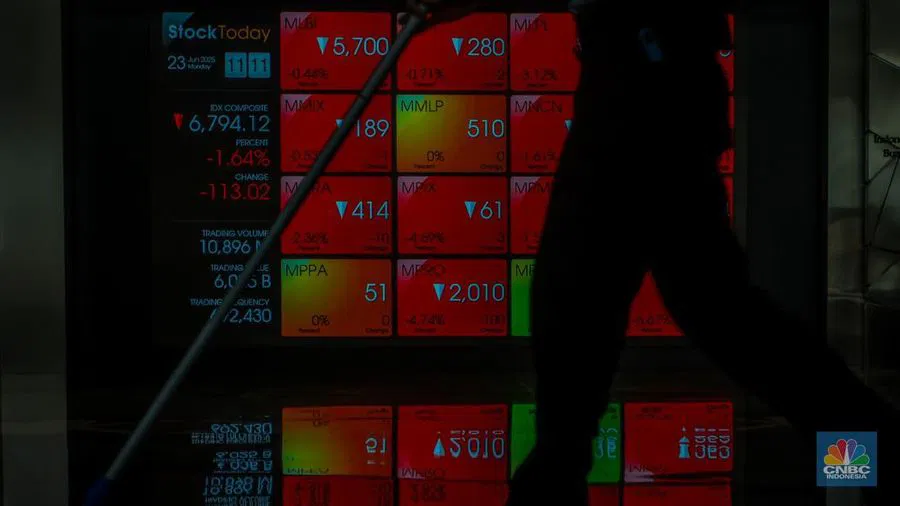
The Indonesian rupiah-denominated assets closed mixed on Wednesday (27-Aug). The JCI index reversed, going up by +0.38% to 7,936.18 after weakening on the previous day by -0.27% (YTD: +12.85%). The turnover posted Rp21.5tn, which was above the YTD average of Rp14.9tn, while foreign investors snapped 11 days of net inflows and posted a net outflow of -Rp212.6bn (YTD: -Rp49.33tn). Regionally, Asian equity markets displayed mixed performance; the Nikkei 225 Index rebounded by +0.30% to 42,520.27 (vs. -0.97% previously, or YTD: +8.29%), while the Shanghai Index dropped sharply by -1.76% to 3,800.35 (vs. -0.39% previously, or YTD: +11.64%).
Indonesian government bonds (INDOGB) continued their upward trend, led by short-to-mid tenors, such as the 5-yr F104 and 10-yr FR103, whose yields have declined by 3.90 bps and 0.3 bps to 5.68% and 6.31%, respectively. However, the yield of the 15-yr FR106 rose slightly by 0.2 bps to 6.68%, while the yield of the 20-yr FR107 was flat at 6.80%. After posting a strong net buy in the previous day of +Rp3.05tn, foreign investors posted a net outflow, reaching -Rp0.89tn, with came across benchmark (-Rp0.6tn), and non-benchmark (-Rp0.3tn). Furthermore, the yield of the 10-yr USD global bond (Mar-2031) edged up slightly by 0.50 bps to 4.45%, and Indonesia s 5-yr CDS went up further to 67.14 (0.16 bps). On the currency front, the rupiah weakened by -0.37% to Rp16,350/USD, continuing the previous trend of -0.25%. Year-to-date, the rupiah has depreciated by 1.50%.
According to IDX s OTC trading report, Indonesian government bond trading activity continued elevated on Wednesday (27-Aug), with total volume rising further to Rp55.7tn (vs. Rp46.5tn on 26-Aug). The figure exceeded the prior week s daily average of Rp39.0tn and stayed well above both the 2025 year-to-date (YTD) daily average of Rp31.0tn and the 2024 daily average of Rp21.7tn. The 5-yr FR0104 series (maturing on 15-Jul-30) dominated market flows, posting Rp6.2tn in trading volume. Its price edged up to 103.50 (+0.15%), driving the yield slightly lower to 5.67% (-3.53 bps). This was followed by the 5.6-yr FR0109 series (maturing on 15-Mar-31), which booked Rp4.9tn in trading volume (vs. Rp6.2tn previously). The bond s price advanced to 101.35 (+0.67%), compressing the yield to 5.59% (-14.21 bps).
On the flow side, based on the latest DMO data (as of 26-Aug), foreign ownership of government bonds has increased slightly to Rp949.2tn (14.87% of outstanding). YTD, BI has been the largest net buyer (+Rp124.6tn), followed by foreign investors (+Rp72.5tn), onshore banks (+Rp70.2tn), insurance and pension funds (+Rp33.3tn), retail (+Rp29.1tn), other investors (+Rp8.5tn), and mutual funds (+Rp6.4tn).
Domestic Corp Bond Market
On the corporate side, trading activity also surged on Wednesday (27-Aug), with total volume more than doubling to Rp7.8tn (vs. Rp3.4tn on 26-Aug). The figure remained above the prior week s daily average of Rp3.1tn, surpassed the 2025 YTD average of Rp3.91tn, and stayed comfortably above the 2024 daily average of Rp2.05tn.
The SMMBMA01ACN2 series (maturing on 27-Aug-26), rated idA(sy), led the segment with Rp1,077bn in trading volume. Its price eased to 99.90 (-0.10%), pushing the yield higher to 7.60% (+10.57 bps). This was followed by the PIDL01CN3 series (maturing on 27-Aug-30), rated idA+, which debuted in the secondary market with Rp588bn in trading volume. The bond traded at 99.85, yielding 10.29%.
Fitch Ratings has affirmed PT Sorik Marapi Geothermal Power’s (SMGP) USD350 million 7.75% senior secured notes due 2031 at ‘BB+’. The Outlook is Stable. According to Fitch, the rating reflects the credit profile of SMGP, which is 95% owned by OTP Geothermal and ultimately controlled by Kaishan Group Co., Ltd. Fitch sees, SMGP benefits from long-term fixed-price power purchase agreements (PPAs) with escalation clauses. These secure the sale of electricity from its geothermal power plant, which uses proven innovative geothermal generation technology, to Indonesian state-owned utility PT Perusahaan Listrik Negara (Persero) (BBB/Stable). The PPA’s take-or-pay (TOP) structure, which covers 90% of the latest unit rated capacity (URC), is tested annually or as required. These features insulate the project from merchant revenue risk.